

For most sports fans, the “nosebleed” section of an arena means being far from the action. But for two UC Riverside alumni, distance is becoming a thing of the past. Imagine sitting in the upper deck of a professional baseball game yet hearing the crisp crack of the bat or the thud of the ball hitting the catcher’s mitt as if you were standing right at home plate.
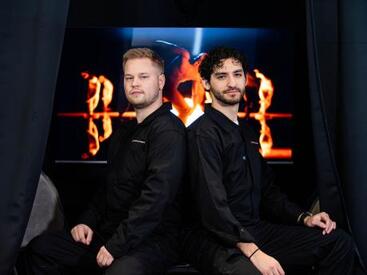
This is the power of Embodied Sound, a revolutionary technology developed by EDGE Sound Research. Founded in 2020 by UCR School of Business graduate Valtteri Salomaki ’18, ’20 MBA and Ethan Castro ’23, Ph.D., the startup is turning audio from something we merely hear into something we feel.
Since then, their company, EDGE Sound Research, has developed multiple patented audio technologies, says Salomaki, “including Embodied Sound for immersive fan experiences and the Virtual Sound Engine to automate sports broadcasting.
“We are working with major broadcasters and leagues, including Fox Sports and the NBA, to bring Virtual Sound Engine into live sports production.”
A Vision Born at UCR
The journey from the classroom to the cutting-edge has been swift. “As a venture spun out of research at UC Riverside, it reflects the tenacity and innovation that UCR students can achieve when they’re given the right resources,” says Salomaki, now CEO of the company.
Their work caught the eye of the City of Riverside Mayor Patricia Lock Dawson, who presented EDGE Sound Research with the 2026 Mayor’s Innovation Award during the State of the City address on Jan. 28, 2026. The award recognizes the company’s role in “leveling up” the city’s reputation as a hub for global tech.
EDGE also recently received investment from audio equipment manufacturer Shure, one of the most respected companies in professional audio. According to an April 2026 Sports Business Journal (SBJ) website article, the collaboration with Shure allows EDGE’s Virtual Sound Engine “to automate mixing audio levels and isolation of audio feeds for sports broadcasters.” For example, they would be able to isolate and distribute different feeds “for alt-casts or operational use (e.g., a referee-specific audio feed.).”
“Because we can capture different streams of [audio] data simultaneous and then change it, manipulate it, record it—our customers, between EDGE and Shure, can monetize it,” says Shure’s Vice President of Strategy and Innovation Scott Sullivan, who was quoted in the journal’s article.
Sports Business Journal also nominated EDGE for the 2026 SBJ Tech Awards for best immersive technology.
Changing the Game
While visual technology has spent decades chasing realism, Salomaki notes that “now it is audio’s turn.” EDGE Sound Research has already made massive inroads into professional sports, creating immersive fan experiences for teams like the Minnesota Twins, Cleveland Cavaliers, and Indiana Pacers, as well as the Indianapolis Motor Speedway.
By isolating specific game sounds and broadcasting them directly through stadium seating, they ensure fans aren’t just watching a game—they are practically in it. This innovation has secured partnerships and research projects with the NBA, Major League Soccer, and Fox Sports.
What’s Next for EDGE?
The company isn’t stopping at the stadium. In partnership with Sweetwater, they are refining technology for home users, allowing a movie night in the living room to feel like a trip into a virtual world.
As they look toward the future, the founders remain proud of their roots. “From first sharing our vision at CES 2020 to showcasing our portfolio of patented technologies at CES 2026, backed by industry leaders such as NBA Investments and the USTA,” says Salomaki, “we’re proud to be Highlanders representing UC Riverside as we continue exploring what’s next in sound.”